

By Hazel James, eCommerce Consultant at SAMM Data
Is an Amazon product description really a single content block, or a distributed ranking asset spread across the entire listing?
On Amazon, what is casually referred to as the “product description” is not confined to one field. It is distributed across the title, bullet points, standard description, A+ Content, backend search terms, and structured attribute data — each contributing differently to search relevance, buyer qualification, listing completeness, and compliance exposure.
That is precisely why many listings underperform even when the copy appears strong in isolation: the issue is rarely a lack of words, but a lack of coordination across fields that Amazon evaluates separately.
This blog breaks down how product description content actually appears across an Amazon listing, what types of content create compliance risk, how each field should be optimized for discoverability and purchase intent, and how product description writing services help.
How Product Descriptions Appear on an Amazon Listing?
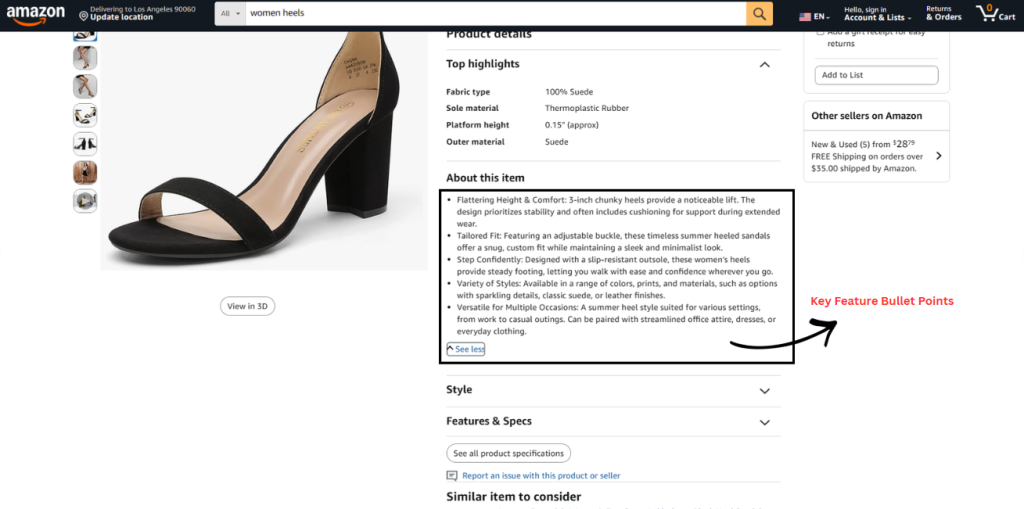
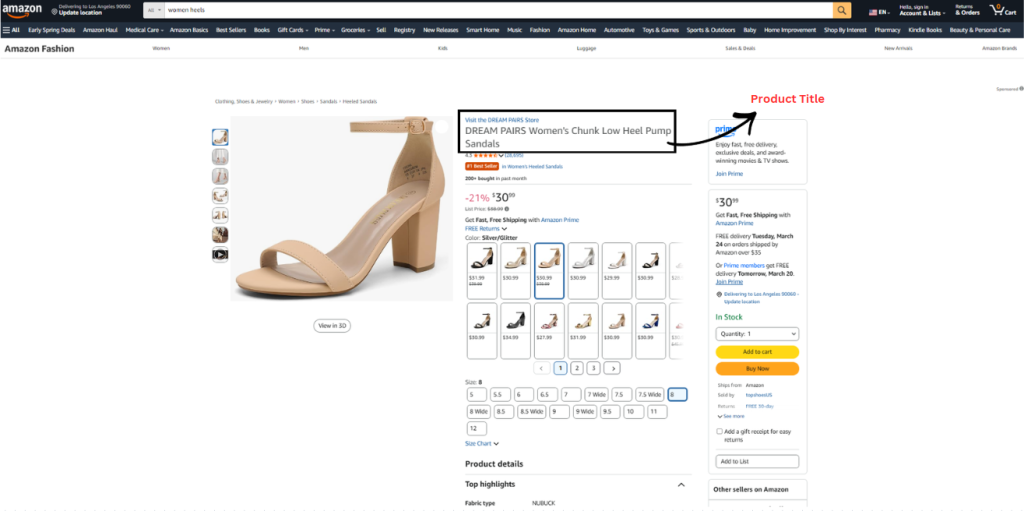
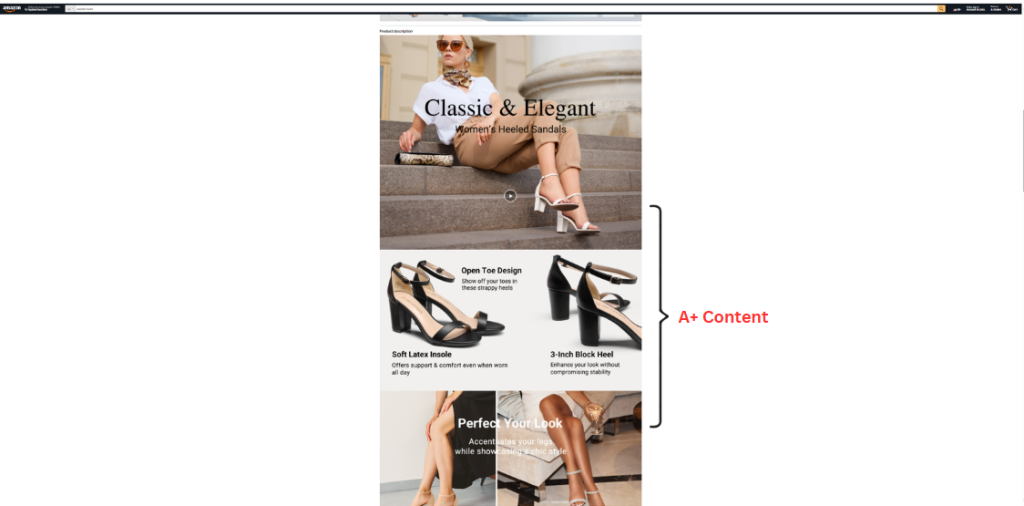
Beyond these, structured attribute data — dimensions, material, weight, country of origin, and similar item specifications — are also components of a complete product description.
Listing Compliance Parameters: Prohibited Content in Amazon Product Descriptions
Amazon imposes specific guardrails on what can and cannot appear in product descriptions. Sellers who are unaware of these restrictions either get their listings suppressed or leave ranking potential untapped.
Promotional language and time-sensitive claims — phrases like “best price,” “on sale,” or “limited-time offer” violate Amazon’s content policy. These belong in Sponsored Ads copy, not organic listings.
Seller contact information — email addresses, phone numbers, URLs, or any reference that directs buyers off-platform- is prohibited and will trigger listing removal.
Subjective quality claims without substantiation — terms like “#1 product” or “world’s best” require verifiable proof. Unsubstantiated superlatives are flagged as misleading.
References to competitor ASINs or brand names — comparative claims that directly name competitors violate Amazon’s terms of service.
HTML in description fields — while Brand Registered sellers can use A+ Content with structured modules, raw HTML tags in standard description fields are stripped and can corrupt formatting.
Shipping or availability-related language — phrases such as “ships in 24 hours” or “in stock” are dynamic attributes managed by Amazon, not seller-controlled description content.
Warranty or guarantee claims not registered with Amazon — any warranty language must be registered through Amazon’s warranty program to be compliant.
How to Optimize Amazon Product Description Writing for SEO & for Better Ranking?
1. Product Title Optimization
A well-structured title typically follows this format: Brand + Core Product Type + Primary Keyword + Key Attribute (size/color/count).
Front-load the highest search volume keyword that also matches purchase intent. Position matters — A9 weights earlier keyword placement more heavily.
Stay within Amazon’s character limits by category (typically 150–200 characters).
Do not repeat keywords from the title in the backend search term field — A9 deduplicates.
2. Bullet Point Architecture
Allocate five bullet points and lead each with a capitalized header phrase, followed by a benefit clause that incorporates a secondary keyword naturally. The header anchors the buyer’s scan; the benefit clause converts it into purchase intent.
Each bullet must answer a distinct purchase question — compatibility, safety, ease of use, included accessories, or warranty terms. Redundancy between bullets wastes both character allocation and indexation coverage.
Stay within 150 to 250 characters per bullet. The 500-character maximum is a technical ceiling, not a target — bullets exceeding 250 characters are truncated in mobile view, where the buyer must actively expand to read the full content.
Avoid special characters, emojis, and symbols, and avoid end-of-line punctuation.
3. A+ Content
For Brand Registered sellers, A+ Content replaces the standard description and introduces visual content modules.
Use the description field to expand on product use cases, compatibility scenarios, and use cases not captured in bullets. Target long-tail keywords here — specific, multi-word search queries that reflect a buyer closer to the point of purchase — where character constraints in the title and bullets would otherwise force them out.
For A+ Content, only text typed directly into module text fields and crawlable headings is indexed — text embedded into images is not. Each image module includes an alt text field of up to 100 characters; optimizing it with relevant keywords extends indexation coverage beyond what title, bullets, and description fields alone capture.
The Case Study: A global framed art retailer faced limited product visibility, suppressed ASINs, and A+ content that did not reflect the brand’s visual merchandising standards. SunTec India restructured listing data, enhanced A+ creatives, and optimized storefront content, contributing to a 20% YOY increase in conversions.
4. Backend Search Terms
Fill the backend search term field to its 250-byte limit — every unused character eliminates a keyword variant A9 could have indexed and a search query the listing could have ranked for.
Use synonyms, phonetic variants, regional spelling differences, and complementary product terms. Example: a listing for “running shoes” should include “jogging trainers,” “athletic footwear,” and relevant activity keywords in backend fields.
The Dual Framework: Customer-Centric vs. Product-Centric Descriptions
1. Customer-Centric Writing
Customer-centric descriptions lead with the buyer’s problem and map product attributes to outcomes.
Lead with the use case, not the product category. “Fits carry-on compartments for domestic and international flights” speaks to a specific purchase scenario. “Compact travel bag” describes a category. A9 indexes both, but only the former matches a buyer who has already decided what they need and is now deciding which product delivers it.
Address the primary purchase objection directly. Every product category has a recurring point of friction where buyers stall before final purchase: size compatibility, material durability, weight limits, and device compatibility. The description should answer that objection explicitly rather than leaving it to the buyer to infer from specifications.
Pair every feature with its functional outcome. “1200D polyester construction — resists abrasion on hard surfaces without adding bulk” gives the buyer a reason that the specification matters. A specification listed without its outcome is data that the buyer has to interpret themselves — friction that reduces conversion.
Ground every benefit in a verifiable outcome. Claims like “transforms your workflow” carry no indexable value and reduce listing credibility. Every benefit stated must be traceable to a measurable product attribute.
2. Product-Centric Writing
Product-centric descriptions establish the technical credibility that comparison-shopping buyers require before committing. Vague attributes create doubt; precise attributes remove the last barrier to purchase.
Use exact measurements, certifications, and compatibility data. “Compatible with ISO 9283 mounting standards” is both indexable and verifiable. “Works with most brackets” is neither — it signals ambiguity where a buyer needs certainty.
Sequence specifications in order of buyer priority. In categories where the buyer evaluates by capability before aesthetics — electronics, kitchen appliances, outdoor gear — weight and dimensions precede color options. The sequence should reflect how the target buyer evaluates, not how the seller ranks product features internally.
Include component-level detail where safety and durability are primary purchase drivers. Electronics, baby products, and health and wellness categories require material and construction specifics — not because they improve readability, but because their absence is itself a trust signal to buyers in those categories.
Each content field must add net-new information. Title, bullets, and description are indexed independently by A9, each with its own character limit. A keyword is indexed once, regardless of how many times it appears across fields — which means every duplicated attribute across title, bullets, and description is a wasted character that could have indexed something new.
The Strategic Imperative: As Amazon product discovery becomes more structured, intent-driven, and compliance-sensitive, businesses that fail to optimize product descriptions risk lower search relevance, lower conversion rates, lower rankings, and a competitive edge in the marketplace.
Professional Amazon product description writing services provide the field-level expertise and scalable execution needed to protect visibility, strengthen listing quality, and sustain competitive position across growing catalogs.
About author


How Modern Storefront Signage Creates Better Customer Experiences and Increases Foot Traffic
In a store of any real size, customers orient themselves using signage the same way they’d use it in an airport or a parking garage. Overhead department signs, aisle markers, and directional signage reduce the friction of “where do I find X” — and every extra minute a customer spends searching is a minute where they might decide to leave instead.

September Isn’t a Shopping Season Anymore. It’s a Moving Target.
September has always been an important reset for retail. But this year, it offers a useful reminder that consumers increasingly dictate their own shopping calendar.

Always Adapting: How To Incorporate Innovative Tech and New Strategies into Your Marketing
The first and most basic way to incorporate new marketing strategies is by encouraging innovation and creative risk at your firm. Teams sometimes have to think in new and exciting ways to make moves when old tactics are no longer working as they used to. Leaders need to embrace the most reliable parts of classic methods while experimenting with innovative tools and new strategies.

Why relevance is retail’s next competitive advantage.
The study of over 1,000 U.S. consumers makes it clear: the issue extends beyond inbox fatigue. Generic brand communications are impacting consumer productivity, eroding trust, altering brand perception, and changing how consumers engage with brands.
 for the latest news and job opportunities in retail tech